

Throughout history, social justice and human rights have often been manipulated or ignored, despite being fundamental to the well-being of all people. Human rights are meant to be universal: freedoms and protections guaranteed to every individual, regardless of race, gender, or nationality. Yet, across the globe, many people still lack access to basic rights and necessities. While the United States Constitution provides protections that disregard race, sex, religion, and other status markers, social injustice persists, revealing the deep flaws in how human rights are applied and respected.
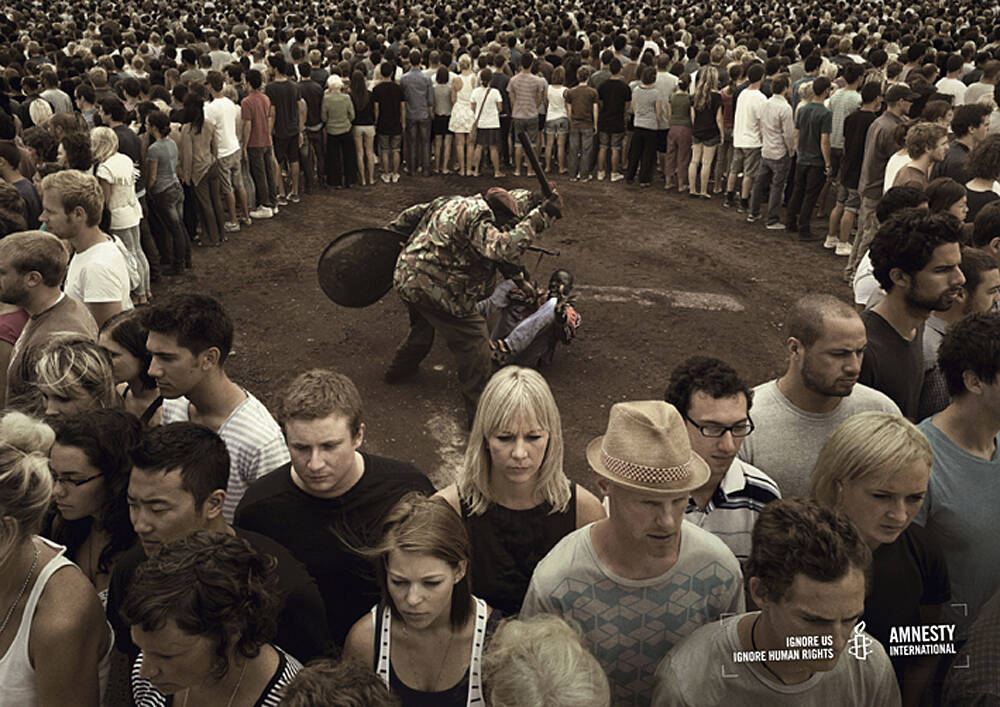
A powerful advertisement created by Amnesty International depicts two men in military uniforms brutally beating a man in public. The victim, lying on the ground, uses his hands in a futile attempt to protect himself. His face shows pain and desperation while the aggressors remain cold and emotionless. Surrounding them are hundreds of people, of all races and genders, yet they turn their backs on the violence. Their blank stares suggest a profound apathy, as they ignore the suffering unfolding before them. The tagline in the bottom corner reads, "Ignore us, ignore human rights." Created by Amnesty International, this image is designed to prompt viewers to reflect on their own moral values and their role in addressing social injustice. The organization challenges individuals to consider: if they were in the victim's place, would they want someone to intervene, or would they allow the violence to continue unnoticed?
Amnesty International, through this ad, critiques the United States government for perpetuating “hate-filled rhetoric” that fuels discrimination and bigotry worldwide. In the wake of controversial policies like Donald Trump’s travel ban, Amnesty launched several campaigns addressing injustices both at home and abroad. The ad emphasizes the responsibility of individuals to act, not only for their own sake but for the sake of others who are suffering. By isolating the viewer in a scenario where they must make a personal choice, it underscores the importance of moral action in the face of injustice. The ad calls upon the values America was founded on, as stated in the Declaration of Independence: "All men are created equal, that they are endowed by their Creator with certain unalienable rights, that among these are Life, Liberty and the pursuit of Happiness." Despite these ideals, systemic violence and discrimination continue to plague the nation, as demonstrated by instances of police brutality. In 2017 alone, over a thousand Americans were killed by police during routine traffic stops or unjust searches. The ad urges society to reflect on its collective role in allowing such issues to persist.
Another critical aspect of the ad is its focus on desensitization—the process by which people become numb to violence and suffering due to overexposure. The crowd depicted in the image represents the erosion of empathy. Surrounded by violence, they seem unaffected, indifferent to the cruelty before them. Desensitization is a growing issue in today’s society, where exposure to violent news or media can dilute emotional responses. This phenomenon is often debated, especially in relation to how media, video games, and films portray violence and crime. The ad forces viewers to confront this reality, placing them in a position where they must address their own potential indifference. It suggests that while hearing about an issue like police brutality or abuse may not have the same impact as witnessing it firsthand, collective disengagement perpetuates the cycle of harm. By directly calling out the viewer, the ad creates an uncomfortable but necessary moment of self-reflection.
Amnesty International has been fighting social injustice for over four decades, but the struggle is far from over. The organization continues to publish ads like this one to remind the world that systemic abuse, murder, and injustice are ongoing issues. By exposing these issues, Amnesty seeks to break the cycle of apathy and compel action. While the ad may not solve these problems immediately, it prompts society to consider its role in advocating for change. For those already committed to human rights, the ad offers reassurance that they are not alone. For others, it serves as a wake-up call, urging individuals to acknowledge their responsibility to support the fight for justice.
The ad’s message is clear: social injustice cannot be ignored. The world cannot afford to remain passive in the face of suffering, and it is incumbent upon each individual to take a stand. Amnesty International’s ad reminds society that it has a moral duty to protect human rights for all people, no matter their background or identity. The choice is clear: will the world remain silent, or will it actively work to end injustice?
Works Cited
“Amnesty International: Street Beating.” RSS, 1 May 2010, https://www.adsoftheworld.com/media/print/amnesty_international_street_beating.
“Countries.” Country Profiles | Amnesty International,
https://www.amnesty.org/en/countries/.
Rogers, Katie. “What Is a Constant Cycle of Violent News Doing to Us?” The New York Times, The New York Times, 15 July 2016,
https://www.nytimes.com/2016/07/16/health/what-is-a-constant-cycle-of-violent-news-doing-to-us.html
“Amnesty International: Street Beating.” RSS, 1 May 2010, https://www.adsoftheworld.com/media/print/amnesty_international_street_beating.
“Countries.” Country Profiles | Amnesty International,
https://www.amnesty.org/en/countries/.
Rogers, Katie. “What Is a Constant Cycle of Violent News Doing to Us?” The New York Times, The New York Times, 15 July 2016,
https://www.nytimes.com/2016/07/16/health/what-is-a-constant-cycle-of-violent-news-doing-to-us.html