
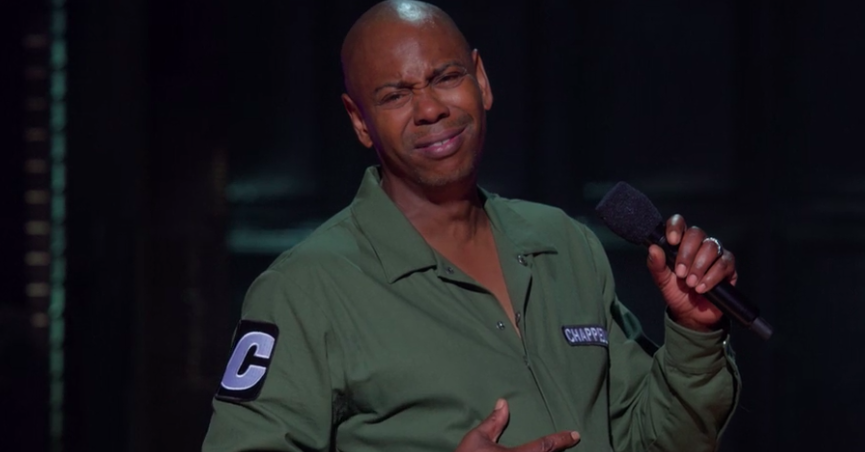

Dave Chappelle’s comedy special Sticks and Stones is a bold exploration of contemporary societal issues, showcasing his signature ability to push boundaries and provoke thought. Known for his legendary stand-up performances and his groundbreaking television program The Chappelle Show, Chappelle has long been a trailblazer in the comedy world. He started his career like many other comedians, performing short sets on platforms like Def Jam Comedy, a series created by Russell Simmons and hosted by D.L. Hughley, which showcased rising comedic talent. Chappelle’s comedy is distinct for its unfiltered, unapologetic style that challenges societal norms and expectations.
Sticks and Stones continues Chappelle’s legacy of daring humor. His career, marked by both triumph and mystery, took a sharp turn in 2005 when he walked away from his wildly successful television show. At the height of his fame, Chappelle retreated from the spotlight, leaving behind an estimated $50 million in potential earnings. In a later interview with David Letterman, Chappelle quipped, “I’m just seven years late to work,” before seriously addressing the pressures of fame. Escaping to South Africa to avoid media scrutiny, Chappelle reflected on his break, expressing minimal regret despite the financial loss. This decision underscores how overwhelming public and critical pressure can be—even for someone at the top of their game.
Chappelle’s approach to comedy is anything but conventional. Unlike family-friendly comedians like Jerry Seinfeld or Jim Gaffigan, Chappelle thrives on making his audience uncomfortable. His unfiltered commentary on controversial topics captivates his viewers, offering biting insights into modern social issues. In Sticks and Stones, he discusses cancel culture, referring to the LGBTQ+ community as “the Alphabet People” and highlighting how reputations are increasingly fragile in the age of outrage. Chappelle critiques how society magnifies past missteps, using Michael Jackson as an example: “The man has been dead for two years and has two brand new cases against him.” This sharp observation exemplifies how today’s culture scrutinizes historical actions with modern sensibilities, often resulting in public backlash.
Cancel culture, as Chappelle describes, has become a phenomenon where individuals are stripped of influence and reputation due to questionable past actions. Often fueled by social media mobs, it operates on quick judgment and limited nuance. One notable example Chappelle addresses is fellow comedian Kevin Hart, who faced intense criticism for a decade-old homophobic joke. The controversy led to Hart stepping down as the host of the Oscars after refusing to issue another apology. For Chappelle, this situation epitomizes the dangers of cancel culture: an unforgiving environment where no misstep goes unnoticed and no apology is ever enough.
In today’s climate, where being both politically correct and funny seems nearly impossible, comedians face unprecedented challenges. Comedy has traditionally been a platform for pushing boundaries and challenging taboos, but societal sensitivities now often overshadow the art form’s purpose. As a result, many feel entitled to dictate what can and cannot be said, eroding the freedom of expression that comedy relies on. Critics and journalists capitalize on public outrage to generate sensational headlines, perpetuating a mob mentality. For example, upon its release, Sticks and Stones received a dismal 0% critic score on Rotten Tomatoes. Critics labeled it “unbearable” and even urged audiences to avoid it entirely. However, once the public weighed in, the special earned a glowing 96% audience score, highlighting the disconnect between critics and viewers.
Despite the evolving landscape of comedy, its core purpose remains unchanged: to provide relief from life’s tragedies and offer a space for honest reflection. As comedian Dane Baptiste told The Guardian, comedy serves “to rationalize trauma... and [offer] the best alternative to politics and its censored, sycophantic, dishonest nature.” This perspective reinforces that humor, even when provocative, is essential for processing life’s complexities.
In a post-Me Too and Black Lives Matter era, the future of comedy remains uncertain, but its ability to adapt and thrive will depend on open-minded audiences willing to laugh at life’s absurdities. Chappelle’s Sticks and Stones stands as a testament to comedy’s resilience and its role in challenging societal norms. At its heart, comedy invites us to confront uncomfortable truths and, ultimately, to find humor in the chaos of life.
Work Cited
Duncan, Kameron. “Entertainment vs. Insensitivity: Can Comedy Go Too Far?” Thedaonline, 29 ` Nov. 2017, https://www.thedaonline.com/opinion/entertainment-vs-insensitivity-can-comedy-go-too-far/article_567fe9f2-d4a3-11e7-81df-e771a737d173.html.
Jeffries, Stuart. “Is Standup Comedy Dead? Exploring the Future of Funny Post-Kevin Hart, Louis CK and Nanette.” The Guardian, Guardian News and Media, 19 Jan. 2019, https://www.theguardian.com/culture/2019/jan/19/is-standup-comedy-doomed-future-of-funny-kevin-hart-louis-ck-nanette.
Hasan, Ilma. “Dave Chappelle's Netflix Special 'Sticks & Stones' Has a Low Rating on Rotten Tomatoes.” Newsweek, Newsweek, 3 Sept. 2019, https://www.newsweek.com/dave-chappelles-netflix-special-sticks-stones-rated-zero-percent-rotten-tomatoes-1457458
“Op-Ed: Outrage Culture Is out of Control.” Los Angeles Times, Los Angeles Times, 22 Feb. 2019, https://www.latimes.com/opinion/op-ed/la-oe-rommelmann-me-too-portland-20190222-story.html.
Wilstein, Matt. “Comedian Bill Burr Rails Against 'Outrage Culture'.” The Daily Beast, The Daily Beast Company, 17 Sept. 2019, https://www.thedailybeast.com/comedian-bill-burr-rails-against-outrage-culture-on-the-last-laugh-podcast.
Duncan, Kameron. “Entertainment vs. Insensitivity: Can Comedy Go Too Far?” Thedaonline, 29 ` Nov. 2017, https://www.thedaonline.com/opinion/entertainment-vs-insensitivity-can-comedy-go-too-far/article_567fe9f2-d4a3-11e7-81df-e771a737d173.html.
Jeffries, Stuart. “Is Standup Comedy Dead? Exploring the Future of Funny Post-Kevin Hart, Louis CK and Nanette.” The Guardian, Guardian News and Media, 19 Jan. 2019, https://www.theguardian.com/culture/2019/jan/19/is-standup-comedy-doomed-future-of-funny-kevin-hart-louis-ck-nanette.
Hasan, Ilma. “Dave Chappelle's Netflix Special 'Sticks & Stones' Has a Low Rating on Rotten Tomatoes.” Newsweek, Newsweek, 3 Sept. 2019, https://www.newsweek.com/dave-chappelles-netflix-special-sticks-stones-rated-zero-percent-rotten-tomatoes-1457458
“Op-Ed: Outrage Culture Is out of Control.” Los Angeles Times, Los Angeles Times, 22 Feb. 2019, https://www.latimes.com/opinion/op-ed/la-oe-rommelmann-me-too-portland-20190222-story.html.
Wilstein, Matt. “Comedian Bill Burr Rails Against 'Outrage Culture'.” The Daily Beast, The Daily Beast Company, 17 Sept. 2019, https://www.thedailybeast.com/comedian-bill-burr-rails-against-outrage-culture-on-the-last-laugh-podcast.